Bill Baterman
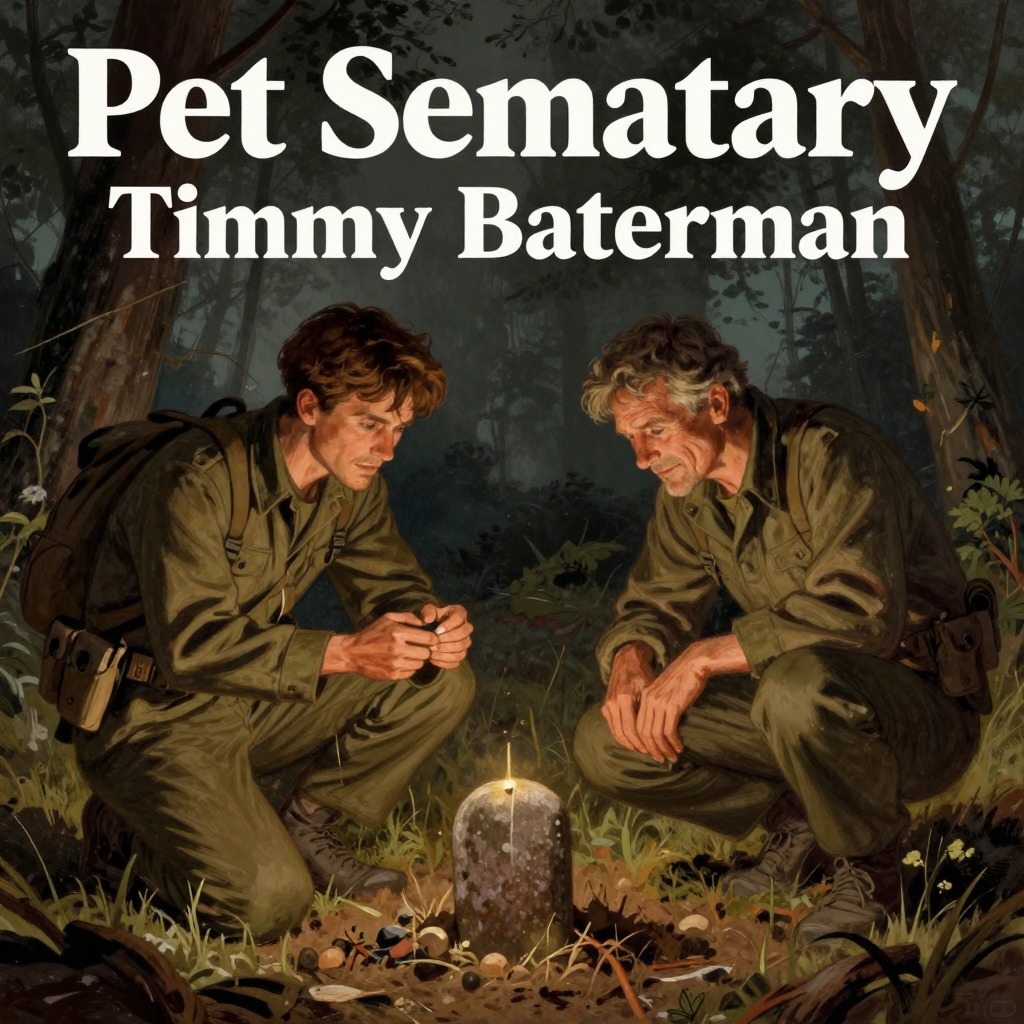
Bill Baterman was a Ludlow man whose only son, Timmy Baterman, was killed in Italy on July 15, 1943, while charging a machine-gun nest, an act that earned him a posthumous Silver Star. When Timmy's body was shipped home and buried with full military honors in Pleasantview Cemetery, Bill Baterman refused to accept the loss. He knew of the Micmac burying ground beyond the Pet Sematary—a place of old, dangerous power—and he decided to use it.
The Exhumation and Resurrection
Bill Baterman secretly disinterred his son's body from its army coffin and carried it to the Micmac burying ground, where he reburied it. The coffin he left behind was later found empty when authorities investigated. Timmy returned from the dead, but he was not the boy who had gone to war. He was changed, and the change was monstrous.
The Return of Timmy Baterman
Timmy Baterman came back walking the roads of Ludlow, dressed in old chino pants and a faded flannel shirt, his hair sticking up, his eyes "like raisins stuck in bread dough." He was seen by multiple townspeople, including the mailwoman Marjorie Washburn and a woman named Mrs. Stratton, who reported that he spoke to her in a knowing, taunting voice. He walked back and forth along the Pedersen Road, a mile east and a mile west of his father's house, day and night. Those who saw him described a creature that was sly, that knew things it should not have known—secrets about the people it encountered. When Jud Crandall and three other men—George Anderson, Hannibal Benson, and Alan Purinton—confronted Bill Baterman at his home, Timmy was there, standing in the yard. He spoke to each man, revealing their hidden shames: Alan Purinton's wife's infidelity, George Anderson's grandson's greed, and Jud Crandall's visits to a whorehouse. The thing that wore Timmy's face knew only the bad, and it used that knowledge to wound and terrorize.
The End of the Baterman Horror
The situation could not continue. The War Department received anonymous letters about the walking corpse, and an investigation loomed. Two nights after the confrontation, the Baterman house burned to the ground. Inside, Bill Baterman was found dead, having shot Timmy twice in the chest with an old Colt .45, then doused the house with range oil and set it ablaze before turning the gun on himself. The county medical examiner determined that Timmy Baterman had been dead for two or three weeks before the fire. Bill Baterman had killed his son a second time, and then himself, to end the abomination.
Narrative Role and Significance
Jud Crandall tells Louis Creed the story of Bill and Timmy Baterman on the night before Gage's burial, hoping to dissuade Louis from attempting the same terrible act. The story is a direct warning: the Micmac burying ground does not restore the dead as they were; it brings back something corrupted, something that knows only evil and delights in destruction. Bill Baterman's grief and desperation mirror Louis's own, and his fate—murdering his own son and then himself—stands as a grim prophecy of what awaits Louis if he follows the same path. The Baterman story is the novel's most explicit cautionary tale, demonstrating that the power of the burial ground is not a gift but a curse, and that "sometimes dead is better."